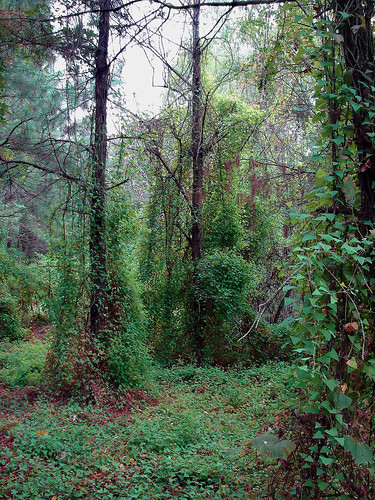
Welcome to the wonderful world of weedy plants!
Weeds are superevolutionary products of human civilizations and activities - without humans there would be no weeds, just wild plants.


Tuesday, October 21, 2014

Positive Poison

(Written by undergraduate student guest blogger from Byrne seminar Fall 2014 at Rutgers)

Ask any Boy Scout, backpacker, hiker, or avid outdoorsman what plant they’re most wary of, and the majority will give you the same answer: poison ivy.  Toxicodendron radicans, more commonly known as poison ivy, is a flowering plant found in North America and Asia.  It is well known for the itching, irritating, and occasionally painful rash contact causes in most people.  This reaction is caused by urushiol, a clear liquid in the sap of the plant, which, contrary to popular belief, serves not as a defense mechanism but as a way to help the plant retain water.  Because of the reaction it causes, poison ivy has gained a rather negative reputation in the eyes of most people.  Various mnemonic devices, such as “leaflets three, let it be”, have been coined to help in identifying and avoiding it. There’s even a super villain from the Batman comics named after it. 
 copyright: Larry Korhnak (http://www.sfrc.ufl.edu/extension/4h/plants/Poison_ivy/)
      Despite its negative effects on humans, poison ivy serves an important and beneficial role in the environment.  The poison ivy plant produces whitish, waxy berries that develop in the summer and persist into the winter, providing a food source for a variety of wildlife, including deer, squirrels, insects, and more than 60 species of birds.  Poison ivy is also very valuable to shoreline and coastal areas where, due to its salt tolerance and ability to grow in nutrient-poor soils, it plays an important role in preventing erosion and protecting sand dunes.  Several species of moths also use poison ivy plants to shelter their larvae while they pupate.
     So while poison ivy is considered a weed by most, it does have a positive side as well.  It just goes to show that even the most harmful and unwanted weeds can have their pluses. 

Monday, September 1, 2014

What will the plants of the future cities look like?

Well, very likely a lot of weeds.  Plants that we do not care much for today, plants that we think are ugly, useless, and unworthy, but that are persistent, drought-tolerant, and very good at surviving in harsh environments (and good ones too!).

Peter del Tredici has written an thought-provoking and great essay on The Flora of the Future: Celebrating the Botanical Diversity of Cities on the website the Design Observer. It is well worth a long, good read, especially if you live in an urbanized area or are interested in ecology and evolution. 

He starts off with a dramatic statement:

"The concept of ecological restoration, as developed over the past 20 years, rests on the mistaken assumption that we can somehow bring back past ecosystems by removing invasive species and replanting native species. This overly simplistic view of the world ignores two basic tenets of modern ecology — that environmental stability is an illusion, and that an unpredictable future belongs to the best adapted." (source link)
In short, nothing stays the same, and especially not now when we have changed the world so much when it comes to species distributions, human-built environments, and changing climates.

Read on... it is spot on and explains what is happening to plants in cities, industrial areas, and abandoned lots...

Friday, August 29, 2014

The "Parking Lot Project": Our Weedy Research Featured in the University Newsroom, 8/20/2014

Our weedy work has MADE it, big time! (Well, sort of...)


As you may or may not know, the creators of this blog form the Struwe research lab (http://www.rci.rutgers.edu/~struwe/at Rutgers University in New Brunswick, NJ, USA. This summer, the Rutgers School of Environmental and Biological Sciences (SEBS) Office of Communication wrote an online news article about one of our campus-based, wild urban plant (aka "weeds"!) biodiversity projects.

Dr. Struwe began this particular project in 2011 after noticing that weedy plant species were abundant right outside of our offices and labs here on Rutgers campus, and especially in the parking lot cracks and curb edges. For the past 3 years, plant surveys of campus parking lots have taken place on a yearly basis. I took the project under my wing this summer by expanding the sampling protocol from previous years and, most importantly, by giving this graduate research endeavor a nickname: the "Parking Lot Project", or "PLP", for short.

This summer was an interesting and exciting time for us in the lab because we had an undergraduate researcher (funded by Rutgers' Aresty Program) to help us with the field work and to develop a sub-project related to urban weeds of her own. Read the article, featuring Dr. Struwe, my undergraduate researcher assistant Alisha, and myself, here.

To all our of amazement, PLP 2014 will have identified over 100 plant species that grow and thrive in the extremely harsh conditions of Rutgers University-New Brunswick campus parking lots once the surveys are completed (and all samples identified!) this fall. Now I call that success!

Friday, April 25, 2014

Eat Your Weeds @ Rutgers Day: How to Safely Savor Wild Edible Plants

Tomorrow, April 26, 2014 is Rutgers Day in New Brunswick, New Jersey! Every year about 70,000 people come to Rutgers, The State University of New Jersey's New Brunswick campus for a huge festival celebrating all that is our university.

The Struwe lab (i.e. the writers and creators of this blog) will host a public outreach and education table entitled "Eat Your Weeds!: How to Safely Savor Wild Edible Plants." We will provide information about weedy plants, advice on urban foraging, and free samples of some original recipes that incorporate weedy plants to everyone who stops by. It will be a lovely way to celebrate the start of the growing season - and the upcoming end of the semester - here on campus!

Here is some information about my current favorite weedy plant and a recipe for a snack that we'll be serving tomorrow, garlic mustard hummus:
Delicious garlic mustard hummus on cracker (with a hairy cress leaf on top). Photo L. Struwe (cc).
Information about garlic mustard, Alliaria petiolata (Brassicaceae), an invasive species.
Recipe for garlic mustard hummus, developed by Sara Morris-Marano.

You can download our recipe handouts at this link, or under Download in the right navigation bar on this blog. 

Thursday, November 7, 2013

Who stole my weeds?

A hilarious news story has been making the rounds recently, about a property owner in Portland, Oregon, who is upset that someone is trespassing and picking the weeds on this property. The story broke on  KATU, a local news station and there are some hilarious comments below it, and then was picked up by Fox News).  The owner is blaming the chefs of neighboring restaurants, and say that not only do they pick the weeds, they leave recipes after them.

To me, this sounds like a April 1 joke (except it wasn't published on the first of April).  First, if you have weeds, wouldn't you be happy to get rid of them?  Second, I doubt chefs would pick weeds in urban lawns that most likely have been sprinkled with pesticides, cat urine, and exhaust fumes plus other unmentionable things.  Third, chefs leaving recipes? This story smells funny all the way from Oregon.  It is possible it is true of course, but that remains to be seen.


search for Urban Edibles in Molenbeek
Urban foraging for edible plants in Belgium. Would you eat the plants from this spot?
Creative Commons photo by foam on Flickr.
However, the idea that chefs would harvest weeds for serving at upscale restaurants are likely and part of a new trend of eating a larger variety of greens, being 'on the edge' of novelty, and of course, being extremely locavorish.  This was already described in the great book Foraged Flavor by Wong and Leroux, and has its roots not only in traditional Italian cuisine with its wild spring greens but also in many other ethnic cuisines.

I grew up picking wild stinging nettles in early spring, when the shoots were small (but still stung).  You had to were gloves, and our patch was so small that only only got enough for one meal per year (or rather, I think we gave up after that).  You cooked the soup down like spinach soup and all the stinginess was gone after boiling, add some cream or milk, and then served with a hard-boiled egg cut in half that floats like two boats in the green sea.  Yummy, and here is a recipe.  The stinging nettles are certainly weeds. 

Monday, October 21, 2013

The good side of an invasive

ă‚¯ă‚º (Kudzu) 

The non-native species Pueraria lobata, commonly known as kudzu (or sometimes mile-a-minute weed, but it is not the same plant as in this blogpost), is a creeping, climbing legume vine from japan and china. “Kudzu” literally means ‘plant’ in Japanese. Like most invasive species, kudzu is considered a noxious weed in our part of the world. The ecological damage caused by this plant is solely due to its ability to out-compete neighboring species for resources such as light. As it grows over other plants, its large leaves blocks sunlight and often plants beneath the kudzu are suffocated. 
Kudzu, The Vine That Ate the South
"The Vine that ate the south." Kudzu invasion in forest.
Creative Commons image by
Frank DiBona on Flickr.

In its home countries, however, it has proven to be a herbal remedy for a variety of troubles such as hair loss and alcoholism. Such two-sided traits beautifully sum up the contradiction of invasive species. Though malicious in some environments, invasive species can be used to our benefit in other area. As seen in our last post about invasives, significant efforts have been put in to mitigate these weeds. However, recent research has shown that some of their characteristics could be beneficial to society.

History
How did kudzu get here? In 1876, during the US’ 100th birthday exposition in Philadelphia, the Japanese government constructed a native Japanese garden for the exhibit. The imagery of the leaves appealed to many American gardeners leading to the vast spread of kudzu in local gardens as ornamental plants from a Florida nursery that propagated and sold the plant. Kudzu was also actively promoted as a forage plant and soil conservation plant in the US during 1930s and 1940s. But it didn’t stay in gardens and on roadsides, it quickly escaped and took over the native forest. 

In addition to this, the US Armed Forces used kudzu as camouflage for equipment in Vanuatu and Fiji in the Pacific. Needless to say, the plant has become classified as an “unwanted organism” in these countries too.
           
The root, flower and leaf from kudzu are used to make herbal medicines. In Traditional Chinese medicine, the use of natural resources is the norm. In fact, the use of herbal-based medication is still a leading treatment for disease in many areas of the world. Kudzu is noted to have been used in Chinese medicine before 600 AD. Its uses range from treatments of menopause symptoms, muscle pain, stomach pain, fever, diarrhea, sinus infections, high blood pressure, to irregular heartbeat, chest pain and various other illnesses.
This medicine features the roots and flowers of the Kudzu plant,
which aims to lessen the desire and craving for alcohol. In addition
it aids the body's natural detoxification processes.
Source: vitaminshoppe.com

Research
Despite its popularity on the Asian continent, the herbal remedy from kudzu has so far lacked sufficient scientific evidence to prove any effects. So can this weed actually help the medical world?

Kudzu promises a remedy for an illness of much importance to society. It has been used to “cure” alcoholism, or more accurately, decrease the symptoms of drinking and the urge to do so. In 2012 Penetar et al published a study conducted at McLean (a hospital affiliated with Harvard University) on kudzu’s effects on alcohol consumption. It was found that physiologically, kudzu can increase the blood flow to the brain and heart. “Wherever blood goes, alcohol goes”, states professor Scott Lukas on the research team. The theory is that this allows for a quicker response time, and the ability for the body to have enough alcohol in less time. Simply put, you get drunk faster on less alcohol. 

First tested on rodents, the intake of alcohol decreased significantly in the lab results when they were given kudzu. When tested on humans, the group treated with kudzu drank significantly less than the placebo group. The research states that alcohol consumption was almost cut in half!  

More research into the how’s and why’s of such effects could lead to very improtant discoveries regarding potential contributions of this invasive species to medicine. 

Check out an old poem written on this historic weed!

Wednesday, October 2, 2013

The minute mile-a-minute mitigator

A minute of natural history

Mile-a-minute overtaking trees.
by Furryscaly via Flickr CC
Mile-a-minute (Persicaria perfoliata) is one of the most pervasive and damaging nonnative invasive plant species in the United States.  Mile-a-minute, a member of the Buckwheat family (Polygonaceae), was first introduced to the U.S. in 1890 from its indigenous range of Asian and Southeast Asia.  The plant did not successfully establish a permanent population in the U.S. until a reintroduction in the late 1930s when a Pennsylvanian nursery germinated Holly seeds from Japan and in doing so, the stowaway mile-a-minute seeds.
Approximate U.S. distribution as of July 2013. Source: Eddmaps.
www.eddmaps.org#sthash.Oa4NZqHa.dpuf


Mile-a-minute earned its name

Mile-a-minute leaves and ocreae. 
by Leslie J. Mehrhoff
Mile-a-minute is an annual trailing vine with distinctive alternate triangular leaves.  Another identifying trait is the round saucer-shaped structures, or ocreae, which occur at nodes and branching points along the stem.  Self-pollinating flowers and subsequent fruit arise from the ocreae. Recurved barbs along the stem and leaf petioles make this plant particularly unpalatable to most potential herbivores.  Low predation rates in the U.S. coupled with the species’ prolific seed production and readily available dispersal mechanisms (water and birds) are traits characteristic of an exceptionally weedy plant.


Following annual die-back mile-a-minute 
leaves and stems continueto weigh down the 
plants they have climbed & shade groundcover.
by L. J. Mehrhoff via Invasives.org
Most impressing, and most ecologically damaging, is mile-a-minute’s growth rate of up to six inches a day, or 77’ (33.8 m) in a single growing season.  For perspective, mile-a-minute could cover the Statue of Liberty from heal to torch in two growing seasons.  Methods to control this invasive plant include traditional methods of manual removal and chemical pesticide applications.  However, given the rate at which mile-a-minute spreads, traditional methods are not practical of well-established or remote populations.  In 1996, the U.S. Forest Service began researching possible biological control agents.  


Fighting nonnative with nonnative: biological control

Biological control is a way of using an invasive species natural predator or disease, most often from the species’ indigenous region, to reduce the invasives’ proliferation and dominance.  Finding a biological control agent that is truly host-specific to your target species takes a lot of research.  Inadequate research into a control agent’s life history and ecology prior to release may have dire consequences, which are worse than the original cause for their introduction.  A classic example of biological control gone awry is that of Cane Toads introduced to Australia in 1937.  Thankfully, the science of introducing biological control agents has come a long way!

Adult R. latipes are approx. 2mm long.
by Amy Diercks, via Invasives.org
Colpetzer et al. published a study in Biological Control (2004) examining potential biological control agents for use on mile-a-minute.  Results from their study supported the introduction of a small host-specific weevil from Asia, Rhinoncomimus latipes, which feeds on mile-a-minute roots as a larvae and foliage as an adult.  In 2004, the U.S. Department of Agriculture approved the use of the weevil as a biological control agent.  After several regional releases, the introduced weevils have successfully established populations throughout the Mid-Atlantic region. 

Ongoing weevil releases, such as one recently conducted in Union County, New Jersey, help sustain and expand the current weevil populations.  Led by state and county agriculture officials, the recent release of 2,000 weevils in Watchung Reservation, Union County’s largest park, is sure to reduce local mile-a-minute growth in the coming years.
 

Below is a video from a weevil release in New York City

Amy Diercks, Bugwood.org

Sunday, August 18, 2013

A Texan Turf War

·        Imagine Dallas for a moment. Not the largest metropolitan area with over a million people, but historic Dallas.  I know what you are thinking of  - miles and miles of… turfgrass! Am I right? No?  Well, according to the city planners in Dallas, a nice green lawn is exactly what they had in mind.  A homeowner with a slightly longer view of history has incurred the ire of the Landmark Commission of Junius Heights Historic District for his “historically inappropriate” yard of cacti, yucca, mesquite, agave, and native prairie grasses.

I realize that the city planners want things to look nice – that is, how things looked when they were growing up in the 60’s , 70’s and 80’s – but I have to question the appropriateness of sod in northern Texas.  To begin with, this area was historically covered with mixed prairie: a super diverse mix of grasses, cacti, and yucca. Even if the Landmark commission adheres to a very short view of history, the ecological appropriateness of using dwindling water supplies to support non-native invasive turfgrass seems misguided and foolish. As is the case in many cities in the Southwest, water supply is dwindling, while water demand is skyrocketing. In 2003 the average Dallas citizen used almost 240 gallons of water a day.

 Xeriscaping seems the most appropriate and responsible choice. And prairies can be beautiful! Check out these photos from the largest remnant of pristine tallgrass prairie. Waves of rolling prairie grasses would be a gorgeous addition to suburbia. 

Wednesday, April 3, 2013

Invasive Species Sushi


A Connecticut Sushi chef uses invasive species to re-imagine sushi. Although his dishes showcase invasive aquatic species, his formative experiences were harvesting burdock and lamb's quarters with his mother as a child in New Haven.

How might we re-imagine food using weedy species? Corporate monocultures are arguably as destructive to native habitats as improper fishing practices are in aquatic systems. Many of the cursed weeds of lawns and gardens were once widely considered edible and delicious.

In the comments section of the article, some readers list their own food ideas. Isabel mentions wild mustard greens, purslane, dandelion flowers, kudzu and Japanese knotweed. How do you use weedy plants? Send us your re-imagined weeds salad, tea, or stir-fry recipes!

Wednesday, September 5, 2012

Weed advertising: Verizon

On Verizon Wireless latest poster for their new Samsung smartphone they put a nice fruiting dandelion on the screen. Now why?

Dandelions are kind of like wireless, spread effortlessly with the wind, nearly invisible... Or maybe they just followed the example of the iphone4's poison ivy weed theme..? :)

Species: dandelion, Taraxacum officinale, Asteraceae

Monday, February 20, 2012

Going once, going twice, going invasive!

I just read an interesting article (see citation at bottom) that describes various ways that species become invasive, and if invasive is really a good word to use.   Often there is a lag time between the first introduction until a species becomes common, overwhelming, and invasive.  The author argues that this lag time often is not a result of a biological process, but simply a continuous time for more introductions of the species to the area and human-mediated dispersal. Here are some quotes, laying out this theory:
"A single initial introduction may act as exclusive founding population. In the British Isles, all populations of the highly invasive Japanese knotweed Fallopia japonica are supposed to descend from one single clone probably introduced in 1848."

"Most frequently, however, successful non-native species are introduced repeatedly and often discontinuously over long periods from one or more original ranges into a new one."

"The success of these species was, in terms of naturalisation, poor with 7.4% naturalised. In contrast, 41.2% of the deliberately introduced taxa achieved naturalisation." {this is from a 1912 study in France}
Note the comment at the end, that deliberately introduced and spread taxa are the ones that become invasive, much more so than the accidentals.  The article describes the situation in Germany, but I think you would have a similar case in the US.  Some of our worst weeds were deliberately spread by humans and promoted as solutions to problems (kudzu for soil erosion and multiflora roses for hedges, for example).  Very interesting read.


Article, source for quotes: Kowarik, Ingo. 2003. Human agency in biological invasions: secondary releases foster naturalisation and population expansion of alien plant species. Biological Invasions 5: 293–312, 2003.

Species: Kudzu, Pueraria lobata, Fabaceae.

Sunday, February 19, 2012

From the blogs: The IKEA Maskros Chandelier

The Design Ties blog is writing about the popular lamp from IKEA that was inspired by a dandelion ('maskros' in Swedish) in fruit, with all the little feathery parasols ready to blow off.  Click on this link to the blog, and check out the various photos.  Pretty nice!

[Species: Dandelion, Taraxacum officinale, Asteraceae]

Sunday, February 12, 2012

Some plants have really unusual features.  This edible crop and weed, purslane (Portulaca oleracea), has capsular fruits with a top that 'pops off', so that the seeds are then exposed to weather and wind.  This particular type of capsule is called circumscissile, and for this particular plant is could be that the part that is left below with the seeds functions as a splash cup.  I don't know, but it is not unlikely.  The little black seeds would then splash out of the cup when a raindrop hits the cup, and disperse further than just normal falling down out of the capsule. (Note to myself, research needed!)   

Splash cups are not that common, but also occur in the bird's-nest fungus. While looking up purslane I found out that one plant can produce more than 240 000 seeds per season.  Well, it is good it is edible then.

You can read more about purslane and this photo here

Photo credit (c) Arjo Vanderjagt on Flickr

Species: purslane (Portulaca oleracea, Portulacaceae)

Company named after weeds: Cirsium Garden Design, UK

Cirsium is the name of a garden design company in Hook, Hampshire (UK), and also the Latin genus name for one of the thistle genera. I love their logo - go to their website to see a larger version.

Genus: thistles, Cirsium, Asteraceae

Sunday, February 5, 2012

Interior design: Cow Parsley wallpaper by Vanillaprint

Cow parsley is a weed of Europe, and much loved (at least in Sweden) for its detailed, airy white flower heads in early June. By late fall the fruits are still standing on the dry stalks and they often last partly through the winter. 

It is in the same family as the American Queen Anne's lace (Daucus carota), which is the same species as carrot.

The interior design company Vanillawood in Portland, Oregon, USA, made a wallpaper featuring this species.  It comes in many colors, take a look here. Lovely pattern!

I don't know how or why this company settled on this species, but cow parsley is becoming an invasive weed here in the US. It is classified as a "Class B noxious weed" in Washington State, USA, and is widespread as an invasive weed both in both northwestern and northeastern USA.  It is mostly called wild chervil in the US.

It is a bit disturbing that a lovely wildflower plant you remember from your childhood and that you strongly associate with long Swedish summer nights are suddenly horrible weeds in another country.  The same thing happened to purple loosestrife, which was one of my favorite flowers on the Baltic seashores.  Here in the US it also is a horrible invasive species. 

Image (c) Vanillawood, used with permission.

Species: Anthriscus sylvestris, Apiaceae, cow parsley, wild chervil

Friday, February 3, 2012

Taste testing: Fentiman's soda - Dandelion and Burdock

Fentiman's is a UK brand of sodas licensed to be made in the US. This Dandelion & Burdock version includes extracts from two weeds: dandelion root and burdock root.  It also includes ginger, anise, and pear. I wrote about this weedy product earlier, but here is a more scientific investigation.

I had a little taste test of this carbonated drink that I found (surprisingly!) in a local supermarket.  I asked over 20 students and family members to write down their thoughts on the smell and the taste and if they liked it or not.  The result?  Overwhelming positive!  Funny enough, many people said it smelled like bubblegum, and in particular Bazooka Bubblegum.  I better look that up, maybe there is some burdock in the Bazooka brand.


Comments from tasters:
Tastes like bubble gum. Tastes exactly how it smells
Strong smell – mellow taste – almost like cream soda/root beer – I liked it
Harsh nose – alcoholic almost – light on palate – doesn’t hold carbonization – flat – does not linger on palate
Delicious! Smells a little strange, but tastes great!
It’s good. A cross between root beer and bubble gum. And perfectly carbonated.
Love it! I bet it would be good with vanilla ice cream, or by itself as an after-dinner treat.  It has a nice fragrance.
Smell – sweet, like cream soda. Taste – light, not overpowering sweet, bazooka bubblegum aftertaste, but scant.  Overall quite delicious.
It tastes like black licorice, smells like a bad cough medicine.
A grassy licorice taste at first, a sweet aftertaste.
Tastes like Dr. Pepper, mixed with Jaegermeister (I assume it is the herbal qualities I am picking up). There is a slightly cherry or plum sort of undertone that probably gives me the Dr. Pepper. Also reminds me a bit of Ricola throat drops. These are all positive, however. It’s more refreshing than super sweet fruit sodas and colas.
I think it tasted good, light and fresh. Just like cola with some herbs.
Taste like one of the traditional Chinese medicines, a little bitter for the first 5 seconds and then coming with really good sweet taste. I like it!
I found this to be nice and light, less sugar than other sodas.
Overall, not bad, but needs more sugar. Nice texture and taste; aftertaste like bubblegum.
I liked it, but didn’t love it… It’s a bit too sweet for my taste. And very ‘fruity’. I would drink it with no effort, but it is not my favorite drink in the world.
Not enough flavor for a soda.  Maybe more sugar, it lacks a flavor kick.
It is really sweet. I don’t really like it, it is too sweet.
It kind of reminds me of cough syrup.
Weird aftertaste. Reminds me of Peptobismol, but I like that, this is all right. Smell like old-fashioned Amish candy.
It is the best tasting soda I have ever tasted in my life.
It smells good. It tastes good, just too sweet.
There is clove in this smell.
Smell – I really don’t like it, some old weird candy.
Smells like Bazzooka bubble gum.
Species: Dandelion, Taraxacum officinale, Asteraceae
Species: Burdock, Arctium, Asteraceae

Monday, January 30, 2012

Seeds Flying Away

A photo showing the very efficient fruit dispersal by wind of thistles, which are relatives of dandelions. Both are the sunflower family, Asteraceae.

Sunday, January 29, 2012

Art design: Cattails and reeds as fabric print

Swedish designed and printed fabric from Ljungbergs Textiltryck, called 'Kaveldun' (=cat tail). Lovely. Cat tails (Typha) is in its own family, and reed is Phragmites in the grass family.  Both are wetland plants, and common both in Europe and North America. I love the cigar-shaped dense flower heads of the cat tails. Phragmites is among the most widespread plants in the world. There is some artistic freedom in this pattern; in real life cat tail stems never branch as shown in this print.

Species: cattail, Typha sp., Typhaceae
Species: common reed, Phragmites sp., Poaceae
Image © Ljungbergs Textiltryck, 'Kaveldun'

In the news: Survival of agricultural weeds

A press release on ScienceDaily summarizes a new study comparing how long seeds from two species of weeds (Chenopodium and Amaranthus, Amaranthaceae) survive under conventional vs. organic farming:

The answer: no strong conclusion either way, the result is mixed. Here is the original article: LINK (doi: http://dx.doi.org/10.1614/WS-D-10-00142.1)

Thursday, January 26, 2012

A fence won't stop a weed

poison ivy, Toxicodendron radicans, Anacardiaceae by Vilseskogen

Here are some stems of poison ivy, climbing up a chain link fence at Rutgers University campus, without any problems at all. In fact, I bet the plant will win over the fence in a few years.

Species: poison ivy, Toxicodendron radicans, Anacardiaceae
[photo by Vilseskogen on Flickr, Creative Commons]