Welcome to the wonderful world of weedy plants!
Weeds are superevolutionary products of human civilizations and activities - without humans there would be no weeds, just wild plants.


Wednesday, October 2, 2013

The minute mile-a-minute mitigator

A minute of natural history
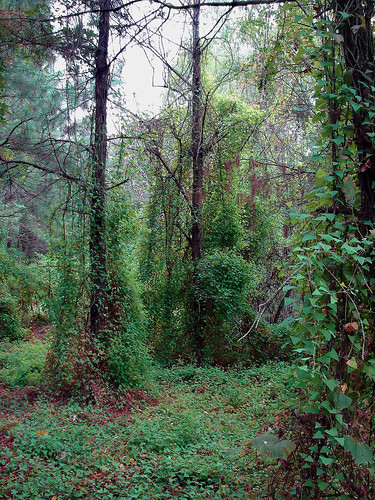
Mile-a-minute overtaking trees.
by Furryscaly via Flickr CC
Mile-a-minute (Persicaria perfoliata) is one of the most pervasive and damaging nonnative invasive plant species in the United States.  Mile-a-minute, a member of the Buckwheat family (Polygonaceae), was first introduced to the U.S. in 1890 from its indigenous range of Asian and Southeast Asia.  The plant did not successfully establish a permanent population in the U.S. until a reintroduction in the late 1930s when a Pennsylvanian nursery germinated Holly seeds from Japan and in doing so, the stowaway mile-a-minute seeds.
Approximate U.S. distribution as of July 2013. Source: Eddmaps.
www.eddmaps.org#sthash.Oa4NZqHa.dpuf


Mile-a-minute earned its name

Mile-a-minute leaves and ocreae. 
by Leslie J. Mehrhoff
Mile-a-minute is an annual trailing vine with distinctive alternate triangular leaves.  Another identifying trait is the round saucer-shaped structures, or ocreae, which occur at nodes and branching points along the stem.  Self-pollinating flowers and subsequent fruit arise from the ocreae. Recurved barbs along the stem and leaf petioles make this plant particularly unpalatable to most potential herbivores.  Low predation rates in the U.S. coupled with the species’ prolific seed production and readily available dispersal mechanisms (water and birds) are traits characteristic of an exceptionally weedy plant.


Following annual die-back mile-a-minute 
leaves and stems continueto weigh down the 
plants they have climbed & shade groundcover.
by L. J. Mehrhoff via Invasives.org
Most impressing, and most ecologically damaging, is mile-a-minute’s growth rate of up to six inches a day, or 77’ (33.8 m) in a single growing season.  For perspective, mile-a-minute could cover the Statue of Liberty from heal to torch in two growing seasons.  Methods to control this invasive plant include traditional methods of manual removal and chemical pesticide applications.  However, given the rate at which mile-a-minute spreads, traditional methods are not practical of well-established or remote populations.  In 1996, the U.S. Forest Service began researching possible biological control agents.  


Fighting nonnative with nonnative: biological control

Biological control is a way of using an invasive species natural predator or disease, most often from the species’ indigenous region, to reduce the invasives’ proliferation and dominance.  Finding a biological control agent that is truly host-specific to your target species takes a lot of research.  Inadequate research into a control agent’s life history and ecology prior to release may have dire consequences, which are worse than the original cause for their introduction.  A classic example of biological control gone awry is that of Cane Toads introduced to Australia in 1937.  Thankfully, the science of introducing biological control agents has come a long way!

Adult R. latipes are approx. 2mm long.
by Amy Diercks, via Invasives.org
Colpetzer et al. published a study in Biological Control (2004) examining potential biological control agents for use on mile-a-minute.  Results from their study supported the introduction of a small host-specific weevil from Asia, Rhinoncomimus latipes, which feeds on mile-a-minute roots as a larvae and foliage as an adult.  In 2004, the U.S. Department of Agriculture approved the use of the weevil as a biological control agent.  After several regional releases, the introduced weevils have successfully established populations throughout the Mid-Atlantic region. 

Ongoing weevil releases, such as one recently conducted in Union County, New Jersey, help sustain and expand the current weevil populations.  Led by state and county agriculture officials, the recent release of 2,000 weevils in Watchung Reservation, Union County’s largest park, is sure to reduce local mile-a-minute growth in the coming years.
 

Below is a video from a weevil release in New York City

Amy Diercks, Bugwood.org

Sunday, August 18, 2013

A Texan Turf War

·        Imagine Dallas for a moment. Not the largest metropolitan area with over a million people, but historic Dallas.  I know what you are thinking of  - miles and miles of… turfgrass! Am I right? No?  Well, according to the city planners in Dallas, a nice green lawn is exactly what they had in mind.  A homeowner with a slightly longer view of history has incurred the ire of the Landmark Commission of Junius Heights Historic District for his “historically inappropriate” yard of cacti, yucca, mesquite, agave, and native prairie grasses.

I realize that the city planners want things to look nice – that is, how things looked when they were growing up in the 60’s , 70’s and 80’s – but I have to question the appropriateness of sod in northern Texas.  To begin with, this area was historically covered with mixed prairie: a super diverse mix of grasses, cacti, and yucca. Even if the Landmark commission adheres to a very short view of history, the ecological appropriateness of using dwindling water supplies to support non-native invasive turfgrass seems misguided and foolish. As is the case in many cities in the Southwest, water supply is dwindling, while water demand is skyrocketing. In 2003 the average Dallas citizen used almost 240 gallons of water a day.

 Xeriscaping seems the most appropriate and responsible choice. And prairies can be beautiful! Check out these photos from the largest remnant of pristine tallgrass prairie. Waves of rolling prairie grasses would be a gorgeous addition to suburbia. 

Wednesday, April 3, 2013

Invasive Species Sushi


A Connecticut Sushi chef uses invasive species to re-imagine sushi. Although his dishes showcase invasive aquatic species, his formative experiences were harvesting burdock and lamb's quarters with his mother as a child in New Haven.

How might we re-imagine food using weedy species? Corporate monocultures are arguably as destructive to native habitats as improper fishing practices are in aquatic systems. Many of the cursed weeds of lawns and gardens were once widely considered edible and delicious.

In the comments section of the article, some readers list their own food ideas. Isabel mentions wild mustard greens, purslane, dandelion flowers, kudzu and Japanese knotweed. How do you use weedy plants? Send us your re-imagined weeds salad, tea, or stir-fry recipes!

Wednesday, September 5, 2012

Weed advertising: Verizon

On Verizon Wireless latest poster for their new Samsung smartphone they put a nice fruiting dandelion on the screen. Now why?

Dandelions are kind of like wireless, spread effortlessly with the wind, nearly invisible... Or maybe they just followed the example of the iphone4's poison ivy weed theme..? :)

Species: dandelion, Taraxacum officinale, Asteraceae

Monday, February 20, 2012

Going once, going twice, going invasive!

I just read an interesting article (see citation at bottom) that describes various ways that species become invasive, and if invasive is really a good word to use.   Often there is a lag time between the first introduction until a species becomes common, overwhelming, and invasive.  The author argues that this lag time often is not a result of a biological process, but simply a continuous time for more introductions of the species to the area and human-mediated dispersal. Here are some quotes, laying out this theory:
"A single initial introduction may act as exclusive founding population. In the British Isles, all populations of the highly invasive Japanese knotweed Fallopia japonica are supposed to descend from one single clone probably introduced in 1848."

"Most frequently, however, successful non-native species are introduced repeatedly and often discontinuously over long periods from one or more original ranges into a new one."

"The success of these species was, in terms of naturalisation, poor with 7.4% naturalised. In contrast, 41.2% of the deliberately introduced taxa achieved naturalisation." {this is from a 1912 study in France}
Note the comment at the end, that deliberately introduced and spread taxa are the ones that become invasive, much more so than the accidentals.  The article describes the situation in Germany, but I think you would have a similar case in the US.  Some of our worst weeds were deliberately spread by humans and promoted as solutions to problems (kudzu for soil erosion and multiflora roses for hedges, for example).  Very interesting read.


Article, source for quotes: Kowarik, Ingo. 2003. Human agency in biological invasions: secondary releases foster naturalisation and population expansion of alien plant species. Biological Invasions 5: 293–312, 2003.

Species: Kudzu, Pueraria lobata, Fabaceae.

Sunday, February 19, 2012

From the blogs: The IKEA Maskros Chandelier

The Design Ties blog is writing about the popular lamp from IKEA that was inspired by a dandelion ('maskros' in Swedish) in fruit, with all the little feathery parasols ready to blow off.  Click on this link to the blog, and check out the various photos.  Pretty nice!

[Species: Dandelion, Taraxacum officinale, Asteraceae]

Sunday, February 12, 2012

Some plants have really unusual features.  This edible crop and weed, purslane (Portulaca oleracea), has capsular fruits with a top that 'pops off', so that the seeds are then exposed to weather and wind.  This particular type of capsule is called circumscissile, and for this particular plant is could be that the part that is left below with the seeds functions as a splash cup.  I don't know, but it is not unlikely.  The little black seeds would then splash out of the cup when a raindrop hits the cup, and disperse further than just normal falling down out of the capsule. (Note to myself, research needed!)   

Splash cups are not that common, but also occur in the bird's-nest fungus. While looking up purslane I found out that one plant can produce more than 240 000 seeds per season.  Well, it is good it is edible then.

You can read more about purslane and this photo here

Photo credit (c) Arjo Vanderjagt on Flickr

Species: purslane (Portulaca oleracea, Portulacaceae)

Company named after weeds: Cirsium Garden Design, UK

Cirsium is the name of a garden design company in Hook, Hampshire (UK), and also the Latin genus name for one of the thistle genera. I love their logo - go to their website to see a larger version.

Genus: thistles, Cirsium, Asteraceae

Sunday, February 5, 2012

Interior design: Cow Parsley wallpaper by Vanillaprint

Cow parsley is a weed of Europe, and much loved (at least in Sweden) for its detailed, airy white flower heads in early June. By late fall the fruits are still standing on the dry stalks and they often last partly through the winter. 

It is in the same family as the American Queen Anne's lace (Daucus carota), which is the same species as carrot.

The interior design company Vanillawood in Portland, Oregon, USA, made a wallpaper featuring this species.  It comes in many colors, take a look here. Lovely pattern!

I don't know how or why this company settled on this species, but cow parsley is becoming an invasive weed here in the US. It is classified as a "Class B noxious weed" in Washington State, USA, and is widespread as an invasive weed both in both northwestern and northeastern USA.  It is mostly called wild chervil in the US.

It is a bit disturbing that a lovely wildflower plant you remember from your childhood and that you strongly associate with long Swedish summer nights are suddenly horrible weeds in another country.  The same thing happened to purple loosestrife, which was one of my favorite flowers on the Baltic seashores.  Here in the US it also is a horrible invasive species. 

Image (c) Vanillawood, used with permission.

Species: Anthriscus sylvestris, Apiaceae, cow parsley, wild chervil

Friday, February 3, 2012

Taste testing: Fentiman's soda - Dandelion and Burdock

Fentiman's is a UK brand of sodas licensed to be made in the US. This Dandelion & Burdock version includes extracts from two weeds: dandelion root and burdock root.  It also includes ginger, anise, and pear. I wrote about this weedy product earlier, but here is a more scientific investigation.

I had a little taste test of this carbonated drink that I found (surprisingly!) in a local supermarket.  I asked over 20 students and family members to write down their thoughts on the smell and the taste and if they liked it or not.  The result?  Overwhelming positive!  Funny enough, many people said it smelled like bubblegum, and in particular Bazooka Bubblegum.  I better look that up, maybe there is some burdock in the Bazooka brand.


Comments from tasters:
Tastes like bubble gum. Tastes exactly how it smells
Strong smell – mellow taste – almost like cream soda/root beer – I liked it
Harsh nose – alcoholic almost – light on palate – doesn’t hold carbonization – flat – does not linger on palate
Delicious! Smells a little strange, but tastes great!
It’s good. A cross between root beer and bubble gum. And perfectly carbonated.
Love it! I bet it would be good with vanilla ice cream, or by itself as an after-dinner treat.  It has a nice fragrance.
Smell – sweet, like cream soda. Taste – light, not overpowering sweet, bazooka bubblegum aftertaste, but scant.  Overall quite delicious.
It tastes like black licorice, smells like a bad cough medicine.
A grassy licorice taste at first, a sweet aftertaste.
Tastes like Dr. Pepper, mixed with Jaegermeister (I assume it is the herbal qualities I am picking up). There is a slightly cherry or plum sort of undertone that probably gives me the Dr. Pepper. Also reminds me a bit of Ricola throat drops. These are all positive, however. It’s more refreshing than super sweet fruit sodas and colas.
I think it tasted good, light and fresh. Just like cola with some herbs.
Taste like one of the traditional Chinese medicines, a little bitter for the first 5 seconds and then coming with really good sweet taste. I like it!
I found this to be nice and light, less sugar than other sodas.
Overall, not bad, but needs more sugar. Nice texture and taste; aftertaste like bubblegum.
I liked it, but didn’t love it… It’s a bit too sweet for my taste. And very ‘fruity’. I would drink it with no effort, but it is not my favorite drink in the world.
Not enough flavor for a soda.  Maybe more sugar, it lacks a flavor kick.
It is really sweet. I don’t really like it, it is too sweet.
It kind of reminds me of cough syrup.
Weird aftertaste. Reminds me of Peptobismol, but I like that, this is all right. Smell like old-fashioned Amish candy.
It is the best tasting soda I have ever tasted in my life.
It smells good. It tastes good, just too sweet.
There is clove in this smell.
Smell – I really don’t like it, some old weird candy.
Smells like Bazzooka bubble gum.
Species: Dandelion, Taraxacum officinale, Asteraceae
Species: Burdock, Arctium, Asteraceae

Monday, January 30, 2012

Seeds Flying Away

A photo showing the very efficient fruit dispersal by wind of thistles, which are relatives of dandelions. Both are the sunflower family, Asteraceae.

Sunday, January 29, 2012

Art design: Cattails and reeds as fabric print

Swedish designed and printed fabric from Ljungbergs Textiltryck, called 'Kaveldun' (=cat tail). Lovely. Cat tails (Typha) is in its own family, and reed is Phragmites in the grass family.  Both are wetland plants, and common both in Europe and North America. I love the cigar-shaped dense flower heads of the cat tails. Phragmites is among the most widespread plants in the world. There is some artistic freedom in this pattern; in real life cat tail stems never branch as shown in this print.

Species: cattail, Typha sp., Typhaceae
Species: common reed, Phragmites sp., Poaceae
Image © Ljungbergs Textiltryck, 'Kaveldun'

In the news: Survival of agricultural weeds

A press release on ScienceDaily summarizes a new study comparing how long seeds from two species of weeds (Chenopodium and Amaranthus, Amaranthaceae) survive under conventional vs. organic farming:

The answer: no strong conclusion either way, the result is mixed. Here is the original article: LINK (doi: http://dx.doi.org/10.1614/WS-D-10-00142.1)

Thursday, January 26, 2012

A fence won't stop a weed

poison ivy, Toxicodendron radicans, Anacardiaceae by Vilseskogen

Here are some stems of poison ivy, climbing up a chain link fence at Rutgers University campus, without any problems at all. In fact, I bet the plant will win over the fence in a few years.

Species: poison ivy, Toxicodendron radicans, Anacardiaceae
[photo by Vilseskogen on Flickr, Creative Commons]

Wednesday, January 25, 2012

Weedy moss on a brick building

moss weeds on brick building
Brick wall mosses, photo by Vilseskogen on Flickr (Creative Commons license)

Mosses can be weeds too.  I remember reading that the best way to get rid of moss is to scrub the bricks with bleach with an old toothpaste.  Who would do that?  Remove this gorgeous beauty?

Art design: Dandelion wall paper by MissPrint


There is a very cool wall paper design based on a mobile of dandelions (Taraxacum vulgare, Asteraceae) designed and sold by MissPrint, a small UK company in several colors.
[image used with permission from MissPrint]

Need to see how a dandelion looks like?  Here!
This design actually looks a bit more like Queen Anne's lace when you see the fruiting heads side-ways, but the design is named 'Dandelion' so that the designer's creative freedom showing off.
Species: dandelion, Taraxacum vulgare, Asteraceae

Design: Lamp "Maskros" (= dandelion) from IKEA

Nice!

[photo by Vilseskogen, Flickr, Creative Commons]
Species: dandelion, Taraxacum vulgare, Asteraceae

Species: Multi-flora rose

rosehips from multiflora rose (Rosa multiflora, Rosaceae)
One of the worst weeds in New Jersey is this gorgeous red-fruited rose, multiflora rose (Rosa multiflora).  It spreads its thorny, fast-growing, end-rooting branches like wild fire in the open meadows, and is hard to kill off.  But the fruits, true but small rosehips, are gorgeous in the December sun. This species is a horrible invasive in the US and originally from Asia.

Species: multiflora rose, Rosa multiflora, Rosaceae
[image by Vilseskogen on Flickr, Creative Commons]

Goats love weeds...

They love them so much they eat them to death, and this is being used in Los Angeles (California, USA) by Environmental Land Management who rent out weed-cleaning goats.  You can read the story here in New York Times.

Drought-tolerant gardening in Austin, TX

Instead of pouring rare water over lawns of grasses not adapted to heat and drought, plant a prairie of native plants that you let go brown in the summer drought. A great article on projects like this in Austin, TX was recently published in The New York Times.  A short excerpt, showing how perception is strongly linked to knowledge (or lack thereof) for many people:
“People were asking: ‘What are all these weeds? Why aren’t we mowing?’ ” Mr. Simmons said. So he started giving talks to the community, and his team gave tours and handed out educational material.
“Six months later, when we decided to mow, to make the wildflowers show up better in the spring, we got all these calls saying, ‘Why are you mowing down our prairie?’ ” he said.