Welcome to the wonderful world of weedy plants!
Weeds are superevolutionary products of human civilizations and activities - without humans there would be no weeds, just wild plants.


Showing posts with label invasive. Show all posts

Wednesday, November 19, 2014

Kudzu Has Outsmarted Us

Guest post by Patricia Chan, a freshman in 2014 Byrne seminar on weedy plants

Let me tell you about Pueraria montana var. lobata —it is a crazy, crazy, invasive weed.  This plant, commonly known as Kudzu, but also known as Japanese arrowroot, is a plant in the pea family, Fabacaeae.  You may be thinking: “it’s related to the pea, I guess it probably climbs” (ok you probably didn’t think that, but bear with me).  Well if you were thinking that, you are more than right.  Kudzu is an aggressive and skillful climber, much to the dismay of property owners of the southern United States. But before I tell you about this insane plant, let’s discuss how to recognize it in the wild.
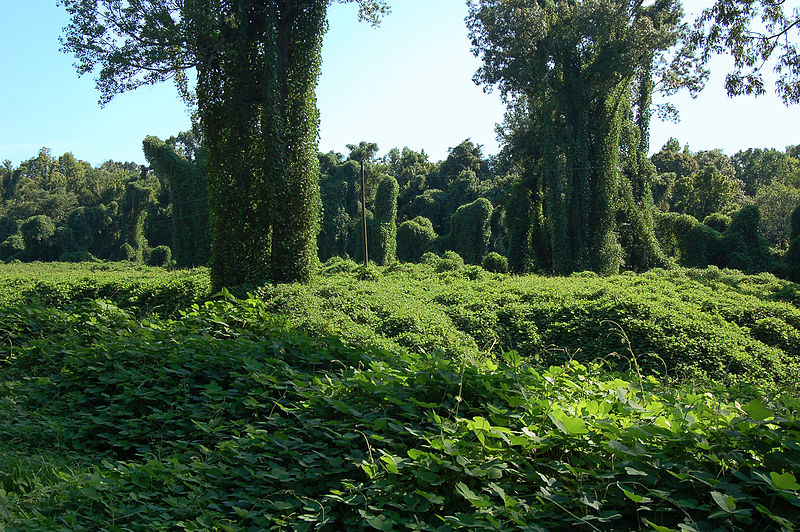
File:Kudzu field horz1.JPG

CC Gsmith 

If you happen to stroll around anywhere in the southeast US and encounter a large green mass where there probably shouldn’t be one  - Congratulations!  You have found Kudzu. Kudzu is a very distinguishable plant from afar due to its tendency to cover large areas.   Up close, it may be slightly harder to recognize.  It’s got compound trifoliate leaves (meaning it has three leaflets on one stem) with a varying number of lobes on each leaflet from 1-3 lobes.  The leaves are fuzzy by the way, like a rabbit.  Like a very small, green, coarse, leaf-shaped rabbit…  The long vines cling to surfaces with little brown bristles that it uses to grapple over trees and buildings.  The flowers are a lovely deep pinkish purple hue and grow in clusters.  That’s nice.

photo by Peggy Greb, public domain 

Anyway, now that you know how to point out Kudzu when you see it, let’s learn more about how it behaves.  Kudzu has a very aggressive growing habit; in the right conditions, it can grow up to one foot per vine a day.  Monstrous.  People have reported losing entire cars to masses of Kudzu because they were parked for a few days.  How crazy is that?  In nature, Kudzu is considered a nuisance because it can envelop entire trees in short periods of time, killing forests by crowding out the light.  What a horrible plant to bring places, one may assume.

With that in mind, how did Kudzu even get here, not being native to this continent?  Maybe by a shipping mistake or a tourist?   No, in fact, Kudzu was brought to this country intentionally from Asia for ornamental and erosion prevention purposes.  That’s right, us humans spread this plant ourselves.  The sad truth is that we didn’t do the research we should have to ensure that this plant didn’t damage our ecosystems the way it did.  We just brought it over on a hypothesis and a whim.

This just goes to show: it’s wise not to mess with the natural order of things.  Not to say that it’s impossible to introduce a foreign species successfully, but a lot of heavy research must be done before it happens to make sure a monster isn’t unleashed.  All in all, Kudzu isn’t actually a wholly evil plant.  It carries medicinal purposes, has beautiful flowers, and it really does prevent erosion.  And in the end, it only behaves the way it because these characteristics have helped it to survive and reproduce in the past.  Kudzu acts to survive, and it just so happens that it is really good at doing that in the US.  What we need to do, however, is be more careful to monitor this kind of thing when considering what exotic plants to put where.  We need to be smart in our ecological decisions.

Tuesday, October 21, 2014

Positive Poison

(Written by undergraduate student guest blogger from Byrne seminar Fall 2014 at Rutgers)

Ask any Boy Scout, backpacker, hiker, or avid outdoorsman what plant they’re most wary of, and the majority will give you the same answer: poison ivy.  Toxicodendron radicans, more commonly known as poison ivy, is a flowering plant found in North America and Asia.  It is well known for the itching, irritating, and occasionally painful rash contact causes in most people.  This reaction is caused by urushiol, a clear liquid in the sap of the plant, which, contrary to popular belief, serves not as a defense mechanism but as a way to help the plant retain water.  Because of the reaction it causes, poison ivy has gained a rather negative reputation in the eyes of most people.  Various mnemonic devices, such as “leaflets three, let it be”, have been coined to help in identifying and avoiding it. There’s even a super villain from the Batman comics named after it. 
 copyright: Larry Korhnak (http://www.sfrc.ufl.edu/extension/4h/plants/Poison_ivy/)
      Despite its negative effects on humans, poison ivy serves an important and beneficial role in the environment.  The poison ivy plant produces whitish, waxy berries that develop in the summer and persist into the winter, providing a food source for a variety of wildlife, including deer, squirrels, insects, and more than 60 species of birds.  Poison ivy is also very valuable to shoreline and coastal areas where, due to its salt tolerance and ability to grow in nutrient-poor soils, it plays an important role in preventing erosion and protecting sand dunes.  Several species of moths also use poison ivy plants to shelter their larvae while they pupate.
     So while poison ivy is considered a weed by most, it does have a positive side as well.  It just goes to show that even the most harmful and unwanted weeds can have their pluses. 

Monday, September 1, 2014

What will the plants of the future cities look like?

Well, very likely a lot of weeds.  Plants that we do not care much for today, plants that we think are ugly, useless, and unworthy, but that are persistent, drought-tolerant, and very good at surviving in harsh environments (and good ones too!).

Peter del Tredici has written an thought-provoking and great essay on The Flora of the Future: Celebrating the Botanical Diversity of Cities on the website the Design Observer. It is well worth a long, good read, especially if you live in an urbanized area or are interested in ecology and evolution. 

He starts off with a dramatic statement:

"The concept of ecological restoration, as developed over the past 20 years, rests on the mistaken assumption that we can somehow bring back past ecosystems by removing invasive species and replanting native species. This overly simplistic view of the world ignores two basic tenets of modern ecology — that environmental stability is an illusion, and that an unpredictable future belongs to the best adapted." (source link)
In short, nothing stays the same, and especially not now when we have changed the world so much when it comes to species distributions, human-built environments, and changing climates.

Read on... it is spot on and explains what is happening to plants in cities, industrial areas, and abandoned lots...

Friday, April 25, 2014

Eat Your Weeds @ Rutgers Day: How to Safely Savor Wild Edible Plants

Tomorrow, April 26, 2014 is Rutgers Day in New Brunswick, New Jersey! Every year about 70,000 people come to Rutgers, The State University of New Jersey's New Brunswick campus for a huge festival celebrating all that is our university.

The Struwe lab (i.e. the writers and creators of this blog) will host a public outreach and education table entitled "Eat Your Weeds!: How to Safely Savor Wild Edible Plants." We will provide information about weedy plants, advice on urban foraging, and free samples of some original recipes that incorporate weedy plants to everyone who stops by. It will be a lovely way to celebrate the start of the growing season - and the upcoming end of the semester - here on campus!

Here is some information about my current favorite weedy plant and a recipe for a snack that we'll be serving tomorrow, garlic mustard hummus:
Delicious garlic mustard hummus on cracker (with a hairy cress leaf on top). Photo L. Struwe (cc).
Information about garlic mustard, Alliaria petiolata (Brassicaceae), an invasive species.
Recipe for garlic mustard hummus, developed by Sara Morris-Marano.

You can download our recipe handouts at this link, or under Download in the right navigation bar on this blog. 

Monday, October 21, 2013

The good side of an invasive

クズ (Kudzu) 

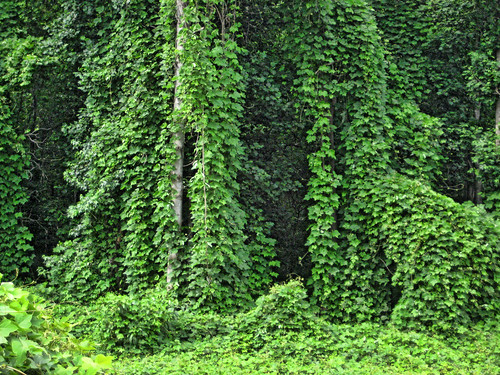
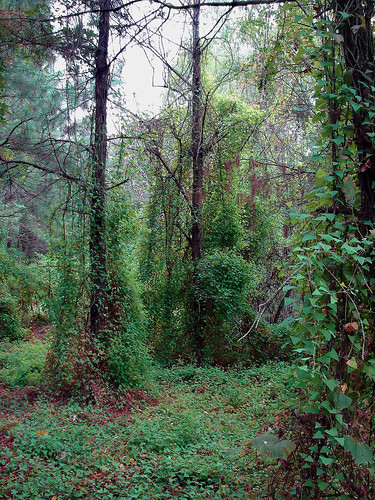
The non-native species Pueraria lobata, commonly known as kudzu (or sometimes mile-a-minute weed, but it is not the same plant as in this blogpost), is a creeping, climbing legume vine from japan and china. “Kudzu” literally means ‘plant’ in Japanese. Like most invasive species, kudzu is considered a noxious weed in our part of the world. The ecological damage caused by this plant is solely due to its ability to out-compete neighboring species for resources such as light. As it grows over other plants, its large leaves blocks sunlight and often plants beneath the kudzu are suffocated. 
Kudzu, The Vine That Ate the South
"The Vine that ate the south." Kudzu invasion in forest.
Creative Commons image by
Frank DiBona on Flickr.

In its home countries, however, it has proven to be a herbal remedy for a variety of troubles such as hair loss and alcoholism. Such two-sided traits beautifully sum up the contradiction of invasive species. Though malicious in some environments, invasive species can be used to our benefit in other area. As seen in our last post about invasives, significant efforts have been put in to mitigate these weeds. However, recent research has shown that some of their characteristics could be beneficial to society.

History
How did kudzu get here? In 1876, during the US’ 100th birthday exposition in Philadelphia, the Japanese government constructed a native Japanese garden for the exhibit. The imagery of the leaves appealed to many American gardeners leading to the vast spread of kudzu in local gardens as ornamental plants from a Florida nursery that propagated and sold the plant. Kudzu was also actively promoted as a forage plant and soil conservation plant in the US during 1930s and 1940s. But it didn’t stay in gardens and on roadsides, it quickly escaped and took over the native forest. 

In addition to this, the US Armed Forces used kudzu as camouflage for equipment in Vanuatu and Fiji in the Pacific. Needless to say, the plant has become classified as an “unwanted organism” in these countries too.
           
The root, flower and leaf from kudzu are used to make herbal medicines. In Traditional Chinese medicine, the use of natural resources is the norm. In fact, the use of herbal-based medication is still a leading treatment for disease in many areas of the world. Kudzu is noted to have been used in Chinese medicine before 600 AD. Its uses range from treatments of menopause symptoms, muscle pain, stomach pain, fever, diarrhea, sinus infections, high blood pressure, to irregular heartbeat, chest pain and various other illnesses.
This medicine features the roots and flowers of the Kudzu plant,
which aims to lessen the desire and craving for alcohol. In addition
it aids the body's natural detoxification processes.
Source: vitaminshoppe.com

Research
Despite its popularity on the Asian continent, the herbal remedy from kudzu has so far lacked sufficient scientific evidence to prove any effects. So can this weed actually help the medical world?

Kudzu promises a remedy for an illness of much importance to society. It has been used to “cure” alcoholism, or more accurately, decrease the symptoms of drinking and the urge to do so. In 2012 Penetar et al published a study conducted at McLean (a hospital affiliated with Harvard University) on kudzu’s effects on alcohol consumption. It was found that physiologically, kudzu can increase the blood flow to the brain and heart. “Wherever blood goes, alcohol goes”, states professor Scott Lukas on the research team. The theory is that this allows for a quicker response time, and the ability for the body to have enough alcohol in less time. Simply put, you get drunk faster on less alcohol. 

First tested on rodents, the intake of alcohol decreased significantly in the lab results when they were given kudzu. When tested on humans, the group treated with kudzu drank significantly less than the placebo group. The research states that alcohol consumption was almost cut in half!  

More research into the how’s and why’s of such effects could lead to very improtant discoveries regarding potential contributions of this invasive species to medicine. 

Check out an old poem written on this historic weed!

Wednesday, October 2, 2013

The minute mile-a-minute mitigator

A minute of natural history

Mile-a-minute overtaking trees.
by Furryscaly via Flickr CC
Mile-a-minute (Persicaria perfoliata) is one of the most pervasive and damaging nonnative invasive plant species in the United States.  Mile-a-minute, a member of the Buckwheat family (Polygonaceae), was first introduced to the U.S. in 1890 from its indigenous range of Asian and Southeast Asia.  The plant did not successfully establish a permanent population in the U.S. until a reintroduction in the late 1930s when a Pennsylvanian nursery germinated Holly seeds from Japan and in doing so, the stowaway mile-a-minute seeds.
Approximate U.S. distribution as of July 2013. Source: Eddmaps.
www.eddmaps.org#sthash.Oa4NZqHa.dpuf


Mile-a-minute earned its name

Mile-a-minute leaves and ocreae. 
by Leslie J. Mehrhoff
Mile-a-minute is an annual trailing vine with distinctive alternate triangular leaves.  Another identifying trait is the round saucer-shaped structures, or ocreae, which occur at nodes and branching points along the stem.  Self-pollinating flowers and subsequent fruit arise from the ocreae. Recurved barbs along the stem and leaf petioles make this plant particularly unpalatable to most potential herbivores.  Low predation rates in the U.S. coupled with the species’ prolific seed production and readily available dispersal mechanisms (water and birds) are traits characteristic of an exceptionally weedy plant.


Following annual die-back mile-a-minute 
leaves and stems continueto weigh down the 
plants they have climbed & shade groundcover.
by L. J. Mehrhoff via Invasives.org
Most impressing, and most ecologically damaging, is mile-a-minute’s growth rate of up to six inches a day, or 77’ (33.8 m) in a single growing season.  For perspective, mile-a-minute could cover the Statue of Liberty from heal to torch in two growing seasons.  Methods to control this invasive plant include traditional methods of manual removal and chemical pesticide applications.  However, given the rate at which mile-a-minute spreads, traditional methods are not practical of well-established or remote populations.  In 1996, the U.S. Forest Service began researching possible biological control agents.  


Fighting nonnative with nonnative: biological control

Biological control is a way of using an invasive species natural predator or disease, most often from the species’ indigenous region, to reduce the invasives’ proliferation and dominance.  Finding a biological control agent that is truly host-specific to your target species takes a lot of research.  Inadequate research into a control agent’s life history and ecology prior to release may have dire consequences, which are worse than the original cause for their introduction.  A classic example of biological control gone awry is that of Cane Toads introduced to Australia in 1937.  Thankfully, the science of introducing biological control agents has come a long way!

Adult R. latipes are approx. 2mm long.
by Amy Diercks, via Invasives.org
Colpetzer et al. published a study in Biological Control (2004) examining potential biological control agents for use on mile-a-minute.  Results from their study supported the introduction of a small host-specific weevil from Asia, Rhinoncomimus latipes, which feeds on mile-a-minute roots as a larvae and foliage as an adult.  In 2004, the U.S. Department of Agriculture approved the use of the weevil as a biological control agent.  After several regional releases, the introduced weevils have successfully established populations throughout the Mid-Atlantic region. 

Ongoing weevil releases, such as one recently conducted in Union County, New Jersey, help sustain and expand the current weevil populations.  Led by state and county agriculture officials, the recent release of 2,000 weevils in Watchung Reservation, Union County’s largest park, is sure to reduce local mile-a-minute growth in the coming years.
 

Below is a video from a weevil release in New York City

Amy Diercks, Bugwood.org

Wednesday, April 3, 2013

Invasive Species Sushi


A Connecticut Sushi chef uses invasive species to re-imagine sushi. Although his dishes showcase invasive aquatic species, his formative experiences were harvesting burdock and lamb's quarters with his mother as a child in New Haven.

How might we re-imagine food using weedy species? Corporate monocultures are arguably as destructive to native habitats as improper fishing practices are in aquatic systems. Many of the cursed weeds of lawns and gardens were once widely considered edible and delicious.

In the comments section of the article, some readers list their own food ideas. Isabel mentions wild mustard greens, purslane, dandelion flowers, kudzu and Japanese knotweed. How do you use weedy plants? Send us your re-imagined weeds salad, tea, or stir-fry recipes!

Monday, February 20, 2012

Going once, going twice, going invasive!

I just read an interesting article (see citation at bottom) that describes various ways that species become invasive, and if invasive is really a good word to use.   Often there is a lag time between the first introduction until a species becomes common, overwhelming, and invasive.  The author argues that this lag time often is not a result of a biological process, but simply a continuous time for more introductions of the species to the area and human-mediated dispersal. Here are some quotes, laying out this theory:
"A single initial introduction may act as exclusive founding population. In the British Isles, all populations of the highly invasive Japanese knotweed Fallopia japonica are supposed to descend from one single clone probably introduced in 1848."

"Most frequently, however, successful non-native species are introduced repeatedly and often discontinuously over long periods from one or more original ranges into a new one."

"The success of these species was, in terms of naturalisation, poor with 7.4% naturalised. In contrast, 41.2% of the deliberately introduced taxa achieved naturalisation." {this is from a 1912 study in France}
Note the comment at the end, that deliberately introduced and spread taxa are the ones that become invasive, much more so than the accidentals.  The article describes the situation in Germany, but I think you would have a similar case in the US.  Some of our worst weeds were deliberately spread by humans and promoted as solutions to problems (kudzu for soil erosion and multiflora roses for hedges, for example).  Very interesting read.


Article, source for quotes: Kowarik, Ingo. 2003. Human agency in biological invasions: secondary releases foster naturalisation and population expansion of alien plant species. Biological Invasions 5: 293–312, 2003.

Species: Kudzu, Pueraria lobata, Fabaceae.

Sunday, February 5, 2012

Interior design: Cow Parsley wallpaper by Vanillaprint

Cow parsley is a weed of Europe, and much loved (at least in Sweden) for its detailed, airy white flower heads in early June. By late fall the fruits are still standing on the dry stalks and they often last partly through the winter. 

It is in the same family as the American Queen Anne's lace (Daucus carota), which is the same species as carrot.

The interior design company Vanillawood in Portland, Oregon, USA, made a wallpaper featuring this species.  It comes in many colors, take a look here. Lovely pattern!

I don't know how or why this company settled on this species, but cow parsley is becoming an invasive weed here in the US. It is classified as a "Class B noxious weed" in Washington State, USA, and is widespread as an invasive weed both in both northwestern and northeastern USA.  It is mostly called wild chervil in the US.

It is a bit disturbing that a lovely wildflower plant you remember from your childhood and that you strongly associate with long Swedish summer nights are suddenly horrible weeds in another country.  The same thing happened to purple loosestrife, which was one of my favorite flowers on the Baltic seashores.  Here in the US it also is a horrible invasive species. 

Image (c) Vanillawood, used with permission.

Species: Anthriscus sylvestris, Apiaceae, cow parsley, wild chervil

Wednesday, January 25, 2012

Species: Multi-flora rose

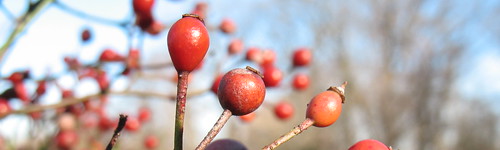
rosehips from multiflora rose (Rosa multiflora, Rosaceae)
One of the worst weeds in New Jersey is this gorgeous red-fruited rose, multiflora rose (Rosa multiflora).  It spreads its thorny, fast-growing, end-rooting branches like wild fire in the open meadows, and is hard to kill off.  But the fruits, true but small rosehips, are gorgeous in the December sun. This species is a horrible invasive in the US and originally from Asia.

Species: multiflora rose, Rosa multiflora, Rosaceae
[image by Vilseskogen on Flickr, Creative Commons]

Red berries mean bird-dispersal

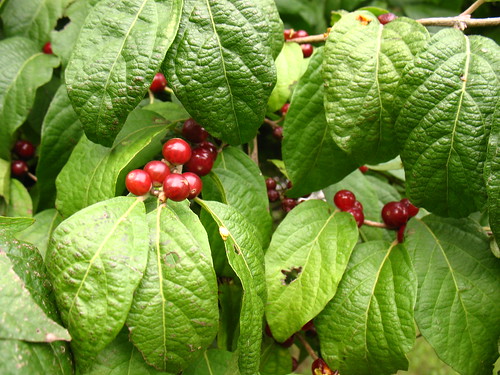
When you see a plant with red, fleshy berries, then its fruits are most likely eaten and dispersed around by birds.  Here is an example, the invasive species Amur honeysuckle (Lonicera mackii, Caprifoliaceae):
honeysuckle, Lonicera maackii, Caprifoliaceae

Birds are attracted to red, a color many other animals can't see, and since birds fly about, bird-dispersed plants are often widely spread, including to far away islands.

Keep in mind that about 50% of red fruits are toxic to humans, but not to birds, since their stomach acids are less strong, and their digestion works faster, so the toxins in the seeds are therefore not affecting the birds as strongly.

Do not eat any red berries if you aren't 100% sure what species it is. Unless you are a bird of course.
[photo by Vilseskogen, Flickr, Creative Commons]

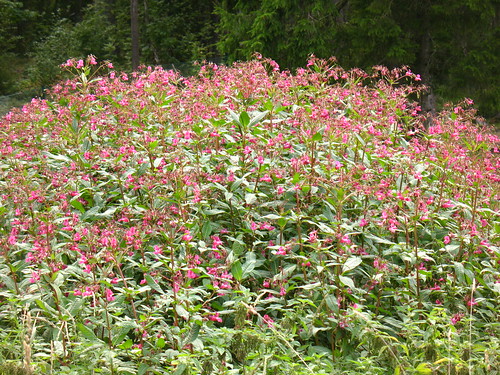
Species: Indian Balsam

Impatient plant (Indian Balsam, Jättebalsamin, Impatiens glandulifera), invasive weed in Sweden


This gorgeous flowering plant, up to 3 m tall, is an invasive wetland and wet soil weed in Sweden.

It is native to India and was first found in Stockholm harbor in 1928, and now it is common in many parts of southern and central Sweden, especially around Stockholm. This photo is from an area north of Stockholm, in Gävle near the Baltic Coast.

The fruits are impatient, thereby the genus name Impatiens. When you touch the mature fruit it explodes in your hand (video here) and the seeds are shot away to new places for new plants to grow. But the flowers of this invasive are gorgeous, dark pink and orchid like.

Species: Indian balsam, Impatiens glandulifera (Balsaminaceae)
[photo credit: Vilseskogen on Flickr, Creative Commons licensing]

Monday, December 19, 2011

Recent weed-related articles in the media

Jane Kramer writes about her foraging adventures in Europe in The New Yorker article The Food at Our Feet.  On the New York Times blog City Room, they have a series in Urban Foraging by Ava Chin, writing about purslane picked from the sidewalks of the city, and much more.

Ecologists have started to argue scientifically about if alien species are necessarily bad or not. It started with an article in Nature (subscription only, so no link, but find it by googling 'doi:10.1038/474153a') by Mark Davis and 18 other ecologists.  This led to a bumper crop of protest letters from many other ecologists (see the issues afterwards in Nature), and it entered the popular media too.  Here is a podcast from Radio Australia about it. 

In an article in TIME magazine, Bryan Walsh ponders if 'In a Globalized World, Are Invasive Species a Thing of the Past?'

Wired adds to the pile, with 'Sometimes Invasive Species are Good'. Wired goes on to describe 9 invasive species worth admiring, including the dandelion weed.

Sunday, December 18, 2011

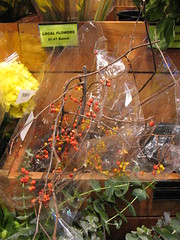
Local Flowers for $7.41 per branch!

The only problem here is that the local flowers are the invasive species Oriental bittersweet, Celastrus orbiculatus, which we rather get rid of. I bet the florist didn't know this. But this is a great use for an alien, invasive weed, don't you think? And to have some people pay over $7 for a branch of unwanted stuff, that is pretty good too. Of course most of them could have gone to any nearby place and cut this down themselves, since this species is omnipresent, fortunately.

Wednesday, December 7, 2011

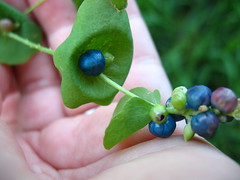
Species: Mile-a-Minute weed

This plant is a horrible invader, grows nearly as fast as its name indicates. But the blue berries are pretty. Probably eaten by birds, I would think. The stems have these sharp hooks on them, which helps the plant to climb up. It is in the same family as rhubarb, smartweed, and buckwheat, the Polygonaceae.
(Polygonum perfoliatum = Persicaria perfoliata, Polygonaceae)

Saturday, July 30, 2011

No more foraging in NYC parks

An article in today's New York Times describes how the park department is planning to crack down on foraging for edible plants (and animals) in the city's parks.

"....New Yorkers are increasingly fanning out across the city’s parks to hunt and gather edible wild plants, like mushrooms, American ginger and elderberries. Now parks officials want them to stop. New York’s public lands are not a communal pantry, they say." (source)

Not all are weeds of course, but many are, and some are also invasive. Personally I think a total ban is wrong, because I want kids to pick a raspberry, and if the Chinese want to gather the smelly ginkgo fruits, let them!  And if the "edible weeds crowd" want to reduce the invasive Japanese knotweed by cutting the young edible spring shoots, that is certainly better than spraying with pesticides later. But hauling turtles out of the park is a different thing.  So as usual, the issue is not as straightforward or black and white as we would like it to be.  It always amazes me that it is illegal to pick mushrooms in America's National Parks for example. Is it better that the mushrooms rot away?  I think it is better that people get closer to nature understand its value, limitations and dangers than that we coop up nature behind laws and bars and signs that tells us to stay away from all green things.