Some plants have really unusual features. This edible crop and weed, purslane (Portulaca oleracea), has capsular fruits with a top that 'pops off', so that the seeds are then exposed to weather and wind. This particular type of capsule is called circumscissile, and for this particular plant is could be that the part that is left below with the seeds functions as a splash cup. I don't know, but it is not unlikely. The little black seeds would then splash out of the cup when a raindrop hits the cup, and disperse further than just normal falling down out of the capsule. (Note to myself, research needed!)
Splash cups are not that common, but also occur in the bird's-nest fungus. While looking up purslane I found out that one plant can produce more than 240 000 seeds per season. Well, it is good it is edible then.
You can read more about purslane and this photo here.
Photo credit (c) Arjo Vanderjagt on Flickr
Species: purslane (Portulaca oleracea, Portulacaceae)
Welcome to the wonderful world of weedy plants!
Weeds are superevolutionary products of human civilizations and activities - without humans there would be no weeds, just wild plants.
Showing posts with label fruits. Show all posts
Sunday, February 12, 2012
Sunday, February 5, 2012
Interior design: Cow Parsley wallpaper by Vanillaprint
Cow parsley is a weed of Europe, and much loved (at least in Sweden) for its detailed, airy white flower heads in early June. By late fall the fruits are still standing on the dry stalks and they often last partly through the winter.
It is in the same family as the American Queen Anne's lace (Daucus carota), which is the same species as carrot.
The interior design company Vanillawood in Portland, Oregon, USA, made a wallpaper featuring this species. It comes in many colors, take a look here. Lovely pattern!
I don't know how or why this company settled on this species, but cow parsley is becoming an invasive weed here in the US. It is classified as a "Class B noxious weed" in Washington State, USA, and is widespread as an invasive weed both in both northwestern and northeastern USA. It is mostly called wild chervil in the US.
It is a bit disturbing that a lovely wildflower plant you remember from your childhood and that you strongly associate with long Swedish summer nights are suddenly horrible weeds in another country. The same thing happened to purple loosestrife, which was one of my favorite flowers on the Baltic seashores. Here in the US it also is a horrible invasive species.
Image (c) Vanillawood, used with permission.
Species: Anthriscus sylvestris, Apiaceae, cow parsley, wild chervil
It is in the same family as the American Queen Anne's lace (Daucus carota), which is the same species as carrot.
The interior design company Vanillawood in Portland, Oregon, USA, made a wallpaper featuring this species. It comes in many colors, take a look here. Lovely pattern!
I don't know how or why this company settled on this species, but cow parsley is becoming an invasive weed here in the US. It is classified as a "Class B noxious weed" in Washington State, USA, and is widespread as an invasive weed both in both northwestern and northeastern USA. It is mostly called wild chervil in the US.
It is a bit disturbing that a lovely wildflower plant you remember from your childhood and that you strongly associate with long Swedish summer nights are suddenly horrible weeds in another country. The same thing happened to purple loosestrife, which was one of my favorite flowers on the Baltic seashores. Here in the US it also is a horrible invasive species.
Image (c) Vanillawood, used with permission.
Species: Anthriscus sylvestris, Apiaceae, cow parsley, wild chervil
Labels:
design,
dispersal,
Europe,
fruits,
graphic design,
interior design,
invasive,
Sweden,
weeds
Monday, January 30, 2012
Seeds Flying Away
A photo showing the very efficient fruit dispersal by wind of thistles, which are relatives of dandelions. Both are the sunflower family, Asteraceae.
Wednesday, January 25, 2012
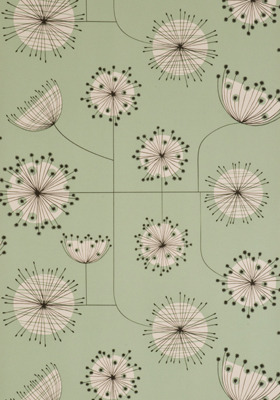
Art design: Dandelion wall paper by MissPrint

There is a very cool wall paper design based on a mobile of dandelions (Taraxacum vulgare, Asteraceae) designed and sold by MissPrint, a small UK company in several colors.
[image used with permission from MissPrint]
Need to see how a dandelion looks like? Here!
This design actually looks a bit more like Queen Anne's lace when you see the fruiting heads side-ways, but the design is named 'Dandelion' so that the designer's creative freedom showing off.
Species: dandelion, Taraxacum vulgare, Asteraceae
Labels:
art,
design,
dispersal,
fruits,
graphic design,
interior design,
weeds
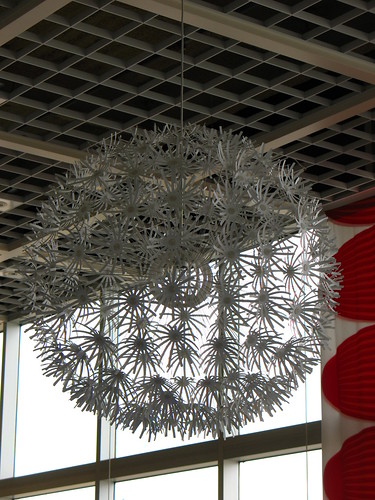
Design: Lamp "Maskros" (= dandelion) from IKEA
Nice!
[photo by Vilseskogen, Flickr, Creative Commons]
Species: dandelion, Taraxacum vulgare, Asteraceae
Species: Multi-flora rose

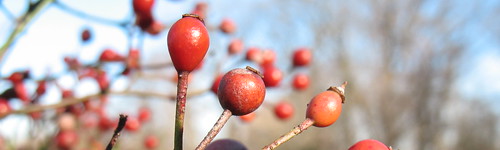
One of the worst weeds in New Jersey is this gorgeous red-fruited rose, multiflora rose (Rosa multiflora). It spreads its thorny, fast-growing, end-rooting branches like wild fire in the open meadows, and is hard to kill off. But the fruits, true but small rosehips, are gorgeous in the December sun. This species is a horrible invasive in the US and originally from Asia.
Species: multiflora rose, Rosa multiflora, Rosaceae
[image by Vilseskogen on Flickr, Creative Commons]
Red berries mean bird-dispersal
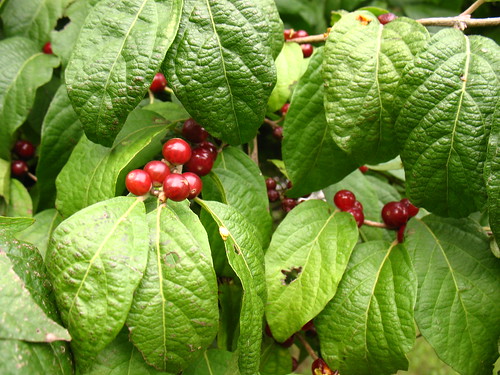
When you see a plant with red, fleshy berries, then its fruits are most likely eaten and dispersed around by birds. Here is an example, the invasive species Amur honeysuckle (Lonicera mackii, Caprifoliaceae):
Birds are attracted to red, a color many other animals can't see, and since birds fly about, bird-dispersed plants are often widely spread, including to far away islands.
Keep in mind that about 50% of red fruits are toxic to humans, but not to birds, since their stomach acids are less strong, and their digestion works faster, so the toxins in the seeds are therefore not affecting the birds as strongly.
Do not eat any red berries if you aren't 100% sure what species it is. Unless you are a bird of course.
[photo by Vilseskogen, Flickr, Creative Commons]
Birds are attracted to red, a color many other animals can't see, and since birds fly about, bird-dispersed plants are often widely spread, including to far away islands.
Keep in mind that about 50% of red fruits are toxic to humans, but not to birds, since their stomach acids are less strong, and their digestion works faster, so the toxins in the seeds are therefore not affecting the birds as strongly.
Do not eat any red berries if you aren't 100% sure what species it is. Unless you are a bird of course.
[photo by Vilseskogen, Flickr, Creative Commons]
Iowa's old cocklebur farms
From an article in New York Times, about how the high crop prices are making farmers plow and put golfcourses and old, unused farmland into agriculture again:
In Iowa, the nation’s biggest producer of corn and soybeans, farmers insist that they are simply getting more value from their land. Darrell Coddington, a farmer who runs an excavation business, has spent much of the past year clearing additional land in the hilly and wooded southern part of the state, including places that used to be left alone and derided as a “cocklebur farm,” referring to the thorny weed.Cocklebur (Xanthium strumarium) is a very interesting-looking plant. It is in the Asteraceae, the sunflower family, but the fruits are covered with horrid, sharp spines (easy to get around if you are stuck to an animal!). It used to be the perfect food for the now extinct parrots of the South; now however, it is an invasive weed that loves rich and often sandy soil. It is a nasty thing to step on and is also toxic. Any good features? Sure, it makes a yellow dye and it repels pests from crop plants close to it.
Monday, August 1, 2011
Richard Mabey's book reviewed in NY Times
The book WEEDS: in Defense of Nature’s Most Unloved Plants by Richard Mabey is reviewed in New York Times today. It is great review, but once again there is a common mistake in how evolution works by the writer of the review (and maybe also by Mabey, I am not sure since I haven't read the book yet):
"One can’t help being impressed by weeds’ ingenuity. They’ve grown hooks, burrs, spines, rib hairs and a sort of glue to move their seeds around."
Weeds haven't grown these things. Plants that had these characters, evolved from genetic variation and mutations over a long time, became weeds because of them. To become a weed is a secondary thing, not something that forces a plant in a certain evolutionary direction.
It is interesting though how our weed project hits exactly the same notes as Mabey's book. History, culture, biology, medicine, and the misunderstood weeds connecting it all.
Labels:
book,
book review,
dispersal,
evolution,
fruits,
killing,
news,
seeds,
united kingdom
Subscribe to:
Posts (Atom)